
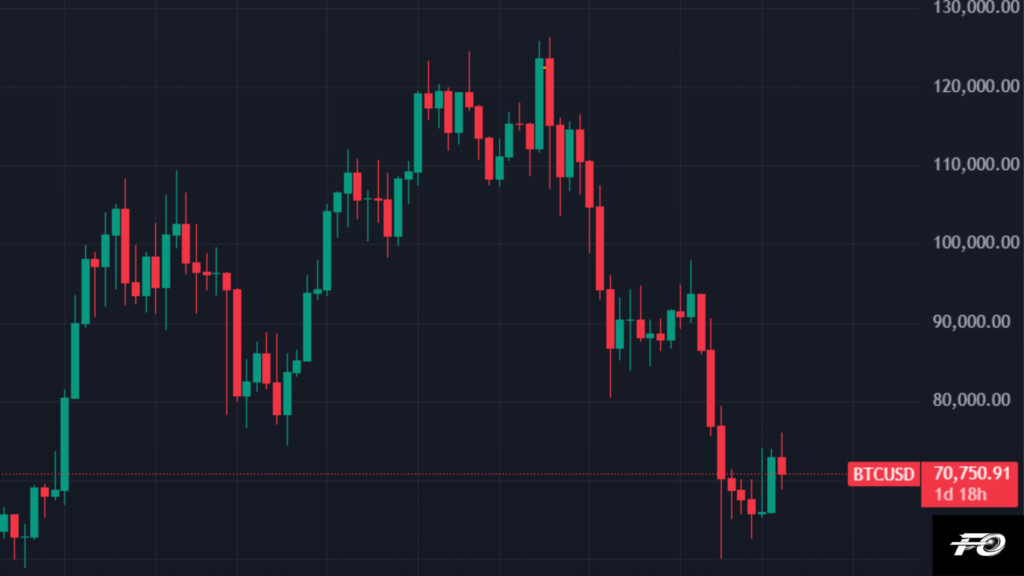
Bitcoin is navigating a prolonged consolidation phase in 2026, trading near $70K after hitting an all-time high of ~$126K in October 2025.
What to know:
- Bitcoin’s supply on exchanges has dropped to its lowest level since 2017 (~0.74% of total supply), meaning less sell-side liquidity — which historically precedes major price moves in either direction.
- Three clear scenarios define 2026’s outlook: a bull breakout toward $90–112K (25–30% chance), a range-bound base case of $60–75K (30–35%), or a bearish slide to $45–55K (40–45%) — with prediction markets currently favoring the downside.
- Macro forces — including persistent inflation, a hawkish Federal Reserve, and the Israel–Iran conflict — are the dominant near-term pressure points, capable of overriding even strong technical or on-chain signals.
After reaching an all-time high of approximately $126,000 in October 2025, Bitcoin entered a sharp correction phase, pulling back 30–45% from its peak. As of March 2026, it trades around $70,000, oscillating within a narrow $68K–$72K range with low trading volume — roughly 61% below prior averages. This kind of compressed, low-conviction trading typically signals that the market is waiting for a decisive catalyst before committing to a direction.
On-chain data paints a cautious picture of network health. Daily active addresses have declined for six consecutive months, falling from approximately 1.2 million to around 1.05 million. Meanwhile, the average coin holder’s cost basis (the “realized price”) sits around $54,900, and ETF investors are, on average, currently underwater on their positions. These signals suggest that while long-term holders remain committed, short-term and institutional participants are under pressure.
Technically, Bitcoin is forming what analysts describe as a “bear flag” — a downward-sloping consolidation pattern beneath the $72K resistance level. If this pattern breaks to the downside, chart models project a potential decline toward the $42,000–$45,000 range. A breakout above $72K–$75K, on the other hand, would invalidate the bearish pattern and open the door to targets in the $80,000–$100,000 range. Either way, the $72K–$75K zone — loaded with options activity — is the most critical technical battleground right now.
The macroeconomic environment remains the biggest wildcard. The Federal Reserve has held rates at 3.5–3.75% with a hawkish tone, and geopolitical shocks — particularly U.S.–Israel strikes on Iran in late February 2026 — have spiked oil prices to around $119 per barrel and delayed expectations for rate cuts. Historically, seven out of eight Fed “hold” decisions in 2025 were followed by Bitcoin price declines, underscoring how sensitive crypto has become to monetary policy signals. A meaningful dovish pivot from the Fed remains the single most powerful potential catalyst for a sustained Bitcoin rally.

Despite the headwinds, structural bullish undercurrents persist. Spot Bitcoin ETFs drew $34 billion in inflows during 2025, and BlackRock’s IBIT alone grew to nearly $100 billion in assets under management. The regulatory environment in the U.S. has turned notably crypto-friendly, with Congress advancing market-structure legislation and the strategic Bitcoin reserve announcement adding symbolic support. These longer-term fundamentals suggest that while the short-term picture is murky, the institutional foundation beneath Bitcoin is stronger than in any previous cycle.
The 2025 ETF Boom and Its Paradox
The explosion of spot Bitcoin ETF products in 2025 offers one of the most instructive case studies in how institutional adoption doesn’t automatically translate into price appreciation. Over the course of 2025, roughly $34 billion flowed into U.S. spot Bitcoin ETFs, with BlackRock’s IBIT becoming one of the fastest-growing ETF products in history — reaching nearly $100 billion in AUM when Bitcoin peaked near $126,000 in October 2025. On the surface, this looked like the ultimate institutional endorsement of Bitcoin as an asset class.
Yet despite record inflows, Bitcoin peaked in October and then declined sharply — illustrating a core market paradox. Much of the ETF buying had already been priced in earlier in the year, meaning the marginal buyer dried up precisely as Bitcoin reached its highest valuation. By early 2026, ETF MVRV (market value to realized value) had turned negative, meaning the average ETF investor was sitting on a loss — a sign of capitulation rather than confidence.
This case study reveals that high inflows alone are not a sufficient condition for sustained price increases; timing, sentiment, and macro context are equally decisive. When the Federal Reserve stayed hawkish and geopolitical tensions escalated, even the structural tailwind of ETF demand couldn’t prevent a 30–45% correction. Investors who bought ETFs near the peak experienced the uncomfortable reality that institutional products can amplify both gains and losses.
The lesson for 2026 is clear: ETF flows should be monitored not just for size, but for direction and momentum. A resumption of consistent weekly inflows could be the trigger that validates the bull case. Conversely, sustained outflows would likely accelerate any downward move, given how much of Bitcoin’s recent price history has been written by institutional hands.
Leave a Reply